
Dark Web Search Engine
The surface web, indexed by Google and Bing, represents only a fraction of the internet. Beneath it lies the dark web, a hidden network accessible only via specialized tools like Tor. Navigating this encrypted space requires more than just a browser—it demands a dark web search engine. Unlike conventional search engines that catalog public pages, these tools crawl .onion domains, offering users a gateway to anonymous forums, marketplaces, and whistleblower sites. Understanding how they function is critical for researchers, journalists, and cybersecurity professionals.
How Does a Dark Web Search Engine Work?
Also, you will need a particular kind of dark web browser to access the dark and deep web. It’s important to remember that the ‘dark web’ is a specific, hidden part of the much larger ‘deep web.’ If you’re unsure about the distinction, our article on dark web vs. deep web uncovers the difference and clears it up perfectly. Search engines for the dark web are highly specialized resources that are designed to search the dark web. Some offer safer, filtered results, while others provide unrestricted access.

Traditional search engines rely on crawlers that follow links from known seed sites. A dark web search engine operates similarly but uses Tor’s hidden services protocol. Crawlers must anonymize their requests, often rotating IP addresses and delaying queries to avoid detection. The index is smaller and more volatile, as many .onion sites disappear or change addresses daily. Examples include Ahmia, Haystak, and Torch.
DarkSearch emphasizes privacy and automation, allowing access to hidden services through a web interface and a free API. Illegal or malicious content may appear in search results Provides no content filtering or protection from harmful sites Suited for users confident in managing unfiltered data without built-in safeguards. Ideal for experienced researchers who need wide and unrestricted visibility across dark web content. Torch’s open indexing approach ensures users can access both mainstream and obscure corners of the dark web.
- Limited Indexing: Most dark web search engines index only a fraction of active .onion sites—often less than 1%.
- Real-Time Updates: Crawlers must revisit sites frequently due to rapid content turnover or server shutdowns.
- Privacy Focus: Unlike Google, these engines do not track user queries or store logs.
Thankfully, some useful sites can help you circumnavigate the dark web landscape as you search for the best content. It has onion links you cannot access with regular browsers like Chrome, Firefox, Edge, or Safari. Haystak is a Dark Web search engine designed for the Tor network. Even in 2025, it remained one of the most recommended Tor search engines in specialized forums. Torch is considered one of the most well-known and long-standing search engines on the Dark Web. Ahmia.fi is a search engine built specifically to allow access to the Dark Web or Dark Net.
Key Features of Dark Web Search Engines
When using a dark web search engine, users encounter distinct characteristics:
No JavaScript or Ads: Many engines strip scripts to reduce security risks, delivering only text and links. Result Transparency: Some display onion links without previews, while others offer snippets. Category Filters: Advanced tools allow filtering by keyword, domain age, or server location.
Popular Dark Web Search Engines
Ahmia is a well-maintained option that blocks child abuse content and offers a clearnet interface. Haystak boasts over 1.5 billion indexed pages, with premium features for a fee. Torch is one of the oldest, but its results are often cluttered with spam. Each engine has trade-offs between index size, uptime reliability, and privacy guarantees.
- It will make your VPN activities seem like normal traffic, so you can use an uncensored internet.
- Many people see hacked information and stolen card data being sold on the dark web.
- Unlike most dark web search engines, the Toorgle search engine allows access to onion sites without requiring the Tor browser.
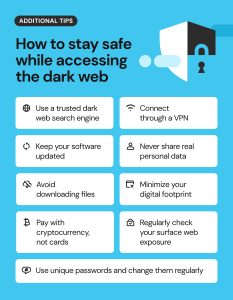
- Users should access search engines through the Tor browser, consider additional VPN protection, avoid downloading unknown files, never reuse personal credentials, and maintain separate devices or virtual machines if possible.
- However, no search engine can make the dark web 100% safe there’s always a risk in clicking unknown links.
FAQs About Dark Web Search Engines
Q: Are dark web search engines safe to use?
A: They are safer than browsing arbitrary .onion links, but results may include malicious sites. Use VPN and Tor for maximum protection.
Q: Can I find illegal content easily?
A: While some engines filter explicit material, others do not. A dark web search engine is a tool—user responsibility determines ethical use.
Q: Why do some engines require CAPTCHA?
A: To prevent automated scraping and DDoS attacks, common on the dark web.
Risks and Limitations
- Phishing Sites: Scammers create fake .onion addresses that mimic legitimate services.
- Outdated Indexes: A site listed today may be a honeypot tomorrow.
- Law Enforcement Monitoring: Some engines are operated or monitored by agencies to track illicit activity.
In conclusion, a dark web search engine is an essential, albeit imperfect, tool for exploring the hidden internet. It offers anonymity and access to uncensored information, but requires caution and technical literacy. Whether for academic research or privacy advocacy, understanding these engines is key to navigating the digital underground responsibly.